AI Brainstorming Toolkit: Fast Ideas in 20 Minutes
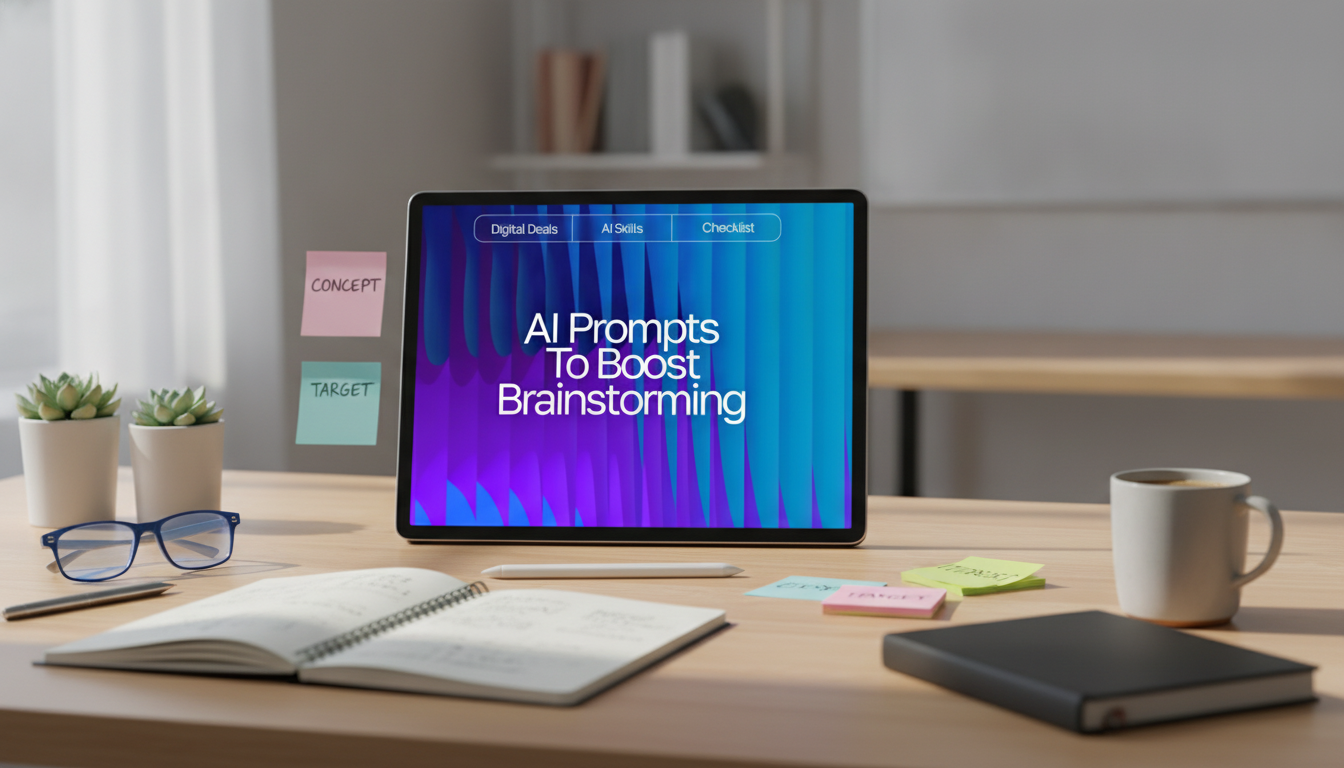
AI Brainstorming Toolkit for Entrepreneurs, Writers, Coaches, and Creatives (Digital Download)
When ideas feel scattered or repetitive, a structured set of AI-ready question cards can turn a vague concept into a clear list of angles, options, and next steps. This digital download is designed for fast sessions that produce usable directions for content, offers, stories, workshops, and campaigns—without staring at a blank page.
If you want a ready-to-run system you can reuse across projects, start with the AI Brainstorming Toolkit (Digital Download). For polishing the final output so it sounds like you, pair it with the Writing Tone Checklist (Digital Download).
What this digital download helps unlock
- More idea volume: quickly generate multiple directions from a single starting thought.
- More idea range: shift perspectives (audience, competitor, contrarian, minimalist, premium) to avoid predictable results.
- Better idea usability: convert raw concepts into actionable formats like hooks, deliverable structures, and testable experiments.
- Less decision fatigue: use guided steps to narrow down to the top options based on effort, impact, and fit.
- Repeatable sessions: run the same workflow weekly for consistent output across projects.
This approach aligns well with design-thinking habits—diverge to explore options, then converge to choose and test. For a practical refresher, see Stanford d.school’s Virtual Crash Course in Design Thinking and Nielsen Norman Group’s Design Thinking 101.
Who it’s for (and how each group can use it)
- Entrepreneurs: generate offer variations, positioning angles, lead magnets, and value ladders from one core expertise area.
- Writers: expand scenes, character motivations, conflict options, themes, and alternate endings; break through “same voice, same plot” loops.
- Coaches and consultants: create session themes, client homework ideas, workshop modules, and reflection questions tailored to different client types.
- Designers and creatives: explore concepts, visual metaphors, campaign themes, names, and constraint-based variations.
- Teams: run fast ideation meetings with consistent structure and fair participation.
Because the questions are modular, you can run a session solo, in a client call, or with a small group. The “win” isn’t just more options—it’s a clean path from messy thinking to a short, ranked list you can execute.
A simple 20-minute idea session (repeatable workflow)
- Minute 1–3: define the target outcome (example: “3 social post angles,” “two offer names,” “five plot twists”) and the audience or user.
- Minute 4–8: ask for expansion using constraints (time, budget, tone, format, channel) to force variety.
- Minute 9–14: ask for alternatives that challenge assumptions (opposite approach, premium vs. budget, beginner vs. advanced).
- Minute 15–18: ask for evaluation (impact, feasibility, differentiation, risks) and rank the top 3.
- Minute 19–20: ask for the next actions (draft, test, structure, script, landing page bullets, experiment plan).
20-minute session: inputs and outputs
| Step | What to provide | What to expect back |
|---|---|---|
| Define | Goal + audience + context | Clear target and boundaries |
| Expand | Constraints + format choices | 10–30 varied directions |
| Challenge | Opposites + trade-offs | Fresh angles and differentiation |
| Select | Criteria (impact/effort/fit) | Ranked shortlist |
| Act | Preferred format + deadline | Next steps and drafts |
Ways to tailor the AI output for stronger results
- Add a role: ask for ideas as a strategist, editor, screenwriter, product manager, or facilitator—then compare results.
- Add boundaries: specify what must be avoided (overused clichés, certain industries, sensitive topics, competitor-like positioning).
- Add examples: include 2–3 references of what “good” looks like (tone, structure, pacing) to reduce generic responses.
- Ask for batches: request 3 sets of 10 ideas in different styles instead of one long list.
- Ask for variations: request the same core idea in different lengths (tagline, paragraph, 60-second script, 5-bullet delivery plan).
If you regularly publish or pitch, it’s worth keeping a small “context block” you reuse: who the audience is, what you sell, what you won’t say, and what success looks like. Small specificity creates a big jump in relevance.
Common sticking points and quick fixes
- Problem: ideas feel too broad → Fix: add a single constraint (platform, audience stage, time limit, price point, genre, or outcome metric).
- Problem: ideas sound the same → Fix: request deliberate contrast (playful vs. serious, minimalist vs. maximalist, contrarian vs. mainstream).
- Problem: too many options → Fix: ask for a scoring matrix using 3 criteria and pick the top 3.
- Problem: results don’t match brand tone → Fix: provide a short “tone sample” paragraph and request matching cadence and vocabulary.
- Problem: paralysis after ideation → Fix: ask for a 7-day micro-plan with one small deliverable per day.
For the tone mismatch problem, the fastest solution is a lightweight standard you can apply across platforms. The Writing Tone Checklist (Digital Download) helps you keep vocabulary, rhythm, and point of view consistent—especially when generating lots of drafts quickly.
What’s included and how to use the file
Try it with these starter use-cases
To get started quickly, open the AI Brainstorming Toolkit (Digital Download), pick one use-case above, and run the 20-minute session once. Save the best outputs and rerun next week with one new constraint.
FAQ
Do I need advanced AI experience to use this?
No. It’s designed for simple copy-and-paste use: provide a goal, name your audience, and add a few constraints, and you’ll get structured options back. It’s beginner-friendly, but flexible enough to support more advanced, detailed inputs.
Will it work for both business ideas and creative writing?
Yes. The same workflow adapts by changing your inputs—like format, genre, audience stage, and desired tone. For business, you can generate offer angles and positioning; for fiction, you can explore conflict, motivations, and alternate turns.
How can the results be made less generic?
Add specific context, include 2–3 examples of what “good” looks like, and apply constraints that force variety. Asking for contrasting batches and then scoring the options helps you refine quickly into a distinctive top three.














Leave a comment